
Claudia Peteau (Apidae), Jonathan Huffstutler, Maxime Blanchard, Clémence Rentet, and Isaline Grand (EONA-X).
Tourism destinations and private operators today rely on a growing diversity of data to understand visitor dynamics, anticipate crowd peaks, and improve the visitor experience — from mobility and weather data to site attendance and tourism offers.
However, this information is often scattered, heterogeneous, and difficult to exploit.
The CyclOps project attempts to tackle this challenge by providing an automated and interoperable software toolbox, built in line with the FAIR principles (Findable, Accessible, Interoperable, Reusable).
CyclOps aims to simplify the discovery, preparation, and use of data within trusted environments.
European data spaces open new opportunities to connect information across stakeholders and build trust — but CyclOps also demonstrates how these exchanges can happen in other frameworks of data collaboration and innovation.
A Common Challenge: Understanding and Managing Visitor Flows
As part of the project, a “Green Deal” pilot is being carried out with Isère Attractivité, the Destination Management Organization (DMO) for the Isère department in France and a member of the Apidae network.
This mountain territory, often facing peaks in tourist attendance, serves as a testing ground to observe and anticipate visitor flows in natural and sensitive areas — helping to protect ecosystems and promote a more balanced form of tourism.

Photo: © Claudia Peteau
Apidae Tourisme, a cooperative data-sharing platform that connects a wide network of tourism organizations and destinations, contributes its expertise and structured API-based tourism data to the project.
In close collaboration with Isère Attractivité, one of its network members, Apidae also provides a territory for experimentation. It is part of the Eona-X ecosystem, supporting trusted data sharing across sectors.
Eona-X, a European data space, plays a central role in the project by facilitating the secure and trusted exchange of data between stakeholders in the tourism, mobility, and transport sectors, and by ensuring the circulation of information from multiple sources, including tourism data, open data, weather, and mobility.
Isère Attractivité selects observation sites, provides their existing available data on visitor flows derived from mobile phone signals, and coordinates its local network to test the tools in real conditions.
On the private side, Avoris Travel Group, one of Europe’s leading tour operators, explores a second dimension of the same use case, focused on AI-powered personalized recommendations.
The company is testing a chatbot assistant designed to help travel advisors offer better guidance by integrating and interpreting multiple data sources — such as weather, holidays, points of interest, and knowledge of customers through CRM information.
This initiative addresses a concrete need: the lack of consistent, real-time data on tourist attendance and trends, which limits the ability to deliver recommendations tailored to each visitor’s expectations.
Through CyclOps, Avoris is testing how the standardization and integration of heterogeneous datasets could, in the future, enable smarter and more context-aware travel advice — paving the way for tools that support both advisor efficiency and traveler satisfaction.
From Raw Data to Decisions: The CyclOps Toolbox in Action
To bring these use cases to life, CyclOps acts as a behind-the-scenes data preparation and analysis toolkit for the technical teams at Anysolution which serves as the technical partner of the project..
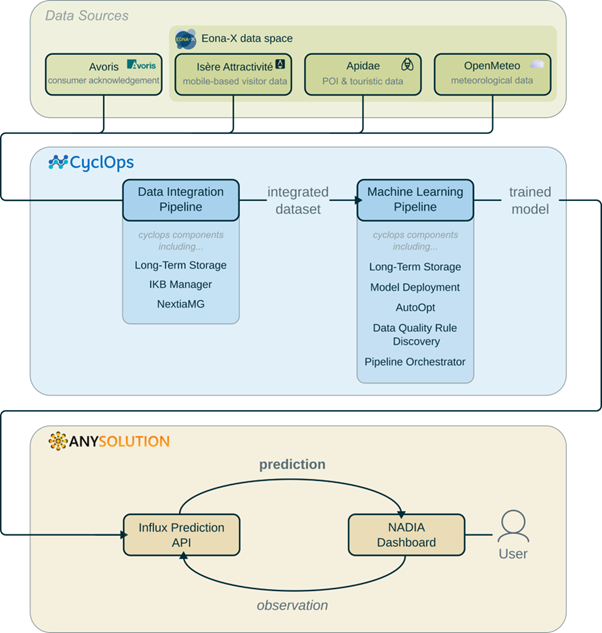
Its purpose is to help engineers and data scientists prepare, combine, and analyze data from different sources (tourism, weather, mobility, attendance, open data) to generate consolidated datasets and AI-based forecasts — the key ingredients for creating operational tools.
These datasets are then used in Nadia, the solution developed by Anysolution.
The Nadia dashboard enables DMOs to visualize visitor flows, identify attendance peaks, and suggest alternatives; later, a chatbot interface will allow users to query this information directly in natural language.
In short, CyclOps prepares the data, and Nadia brings it to life.
The diagram below illustrates the CyclOps process — integration, learning, and prediction — which feeds into the dashboards and services developed for project partners.
Toward Replicable Solutions
After an initial phase of exploration and familiarization, the project is now entering a key stage of collaborative work between the teams of Isère Attractivité, Anysolution, and other CyclOps technical partners.
This phase aims to finalize, test, and validate the relevance of the developed modules through the real-world pilot in Isère.
This use case can be replicated in other European destinations, such as Mallorca.
While the available datasets may vary from one territory to another, the methods of processing and visualization developed through CyclOps can help both destinations and distributors better manage their activities and fully benefit from data space ecosystems.