Written by the CERTH partners
In today’s data-driven world, the hardest problems rarely respect sector boundaries. A flood, a heatwave, an overloaded sewer network — none of these are “water problems” or “energy problems” alone. Yet the data we need to manage them still lives in separate silos, owned by different organisations, in formats that were never designed to talk to one another. The CyclOps project shows how automated, end-to-end data lifecycle management can change that — turning broken silos into shared value.
A horizontal platform for the data lifecycle
Where many initiatives go deep into a single domain, CyclOps takes the opposite, complementary path: it is domain-agnostic by design. Its mission is to provide interoperable, trustworthy, and secure automated management, governance, and maintenance of the entire data lifecycle — for large-scale volumes of data coming from heterogeneous, distributed sources. In short, CyclOps is the automation layer that makes data spaces practical to operate at scale.
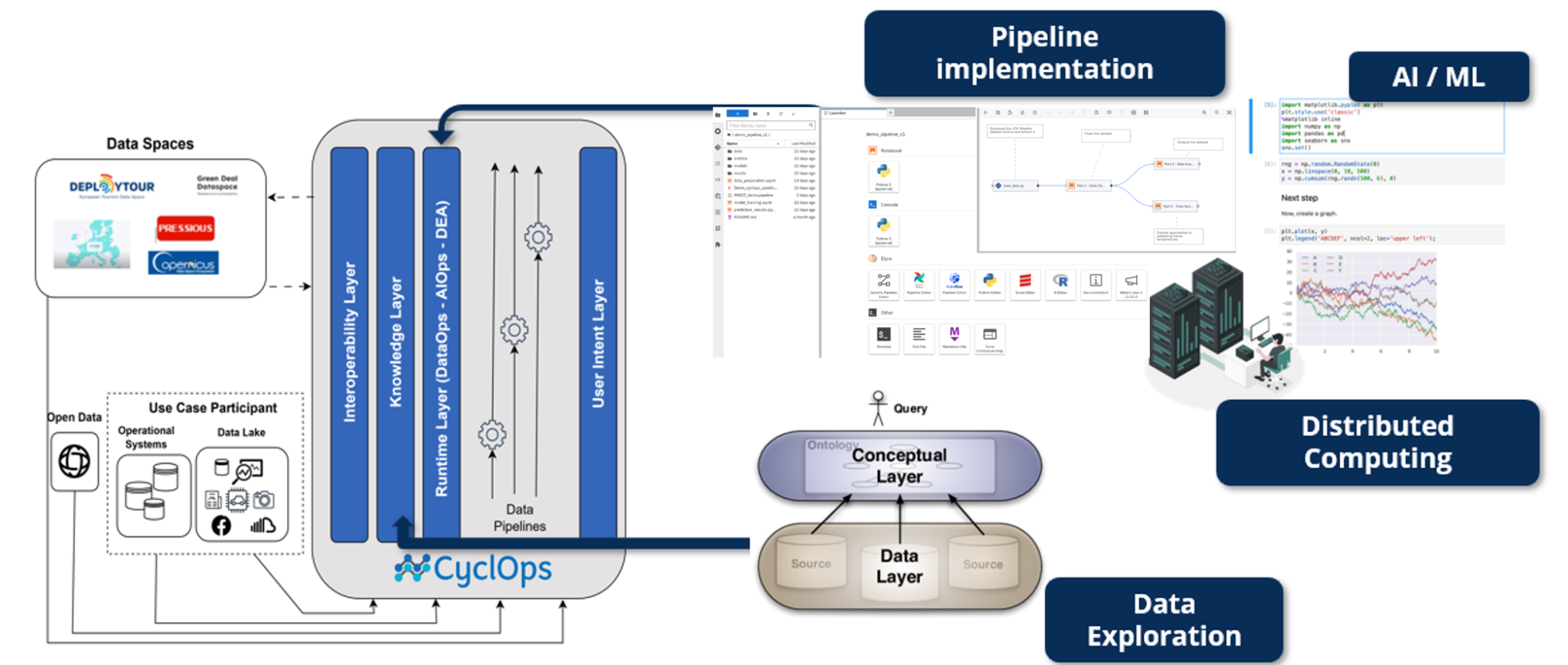
At the heart of the architecture is a layered runtime that bridges two worlds which usually stay apart: data interoperability on one side, and AI operations on the other.
- An Interoperability Layer makes heterogeneous data speak a common language.
- A Knowledge Layer adds semantic context through ontologies and knowledge graphs, with an extensible, agnostic Integrated Knowledge Base that users can customise.
- A Runtime Layer — combining DataOps, AIOps, and a Data and Execution Abstraction (DEA) layer — is where the automation actually executes, from data ingestion and curation through to AI/ML pipelines and distributed processing.
- A User Intent Layer lets users express what they want, without having to engineer the pipeline by hand.
Around this core, CyclOps brings together ontology-driven data exploration, visual pipeline implementation, AI and machine learning, and distributed computing for scale.
From two halves to one picture
A natural complement to CyclOps is WATERVERSE, the Water Data Management Ecosystem that goes deep into the water domain — harmonising heterogeneous water data, making it FAIR, and adding the governance and provenance that let a utility trust it. The two projects aren’t competing approaches to data spaces; they are two halves of the same picture. WATERVERSE supplies the domain depth; CyclOps supplies the automation that lets that data travel and combine with other sectors. And because both are built on the same open foundations — FAIR principles, FIWARE, Smart Data Models — they already speak a common language at the infrastructure level.
A use case that connects everything
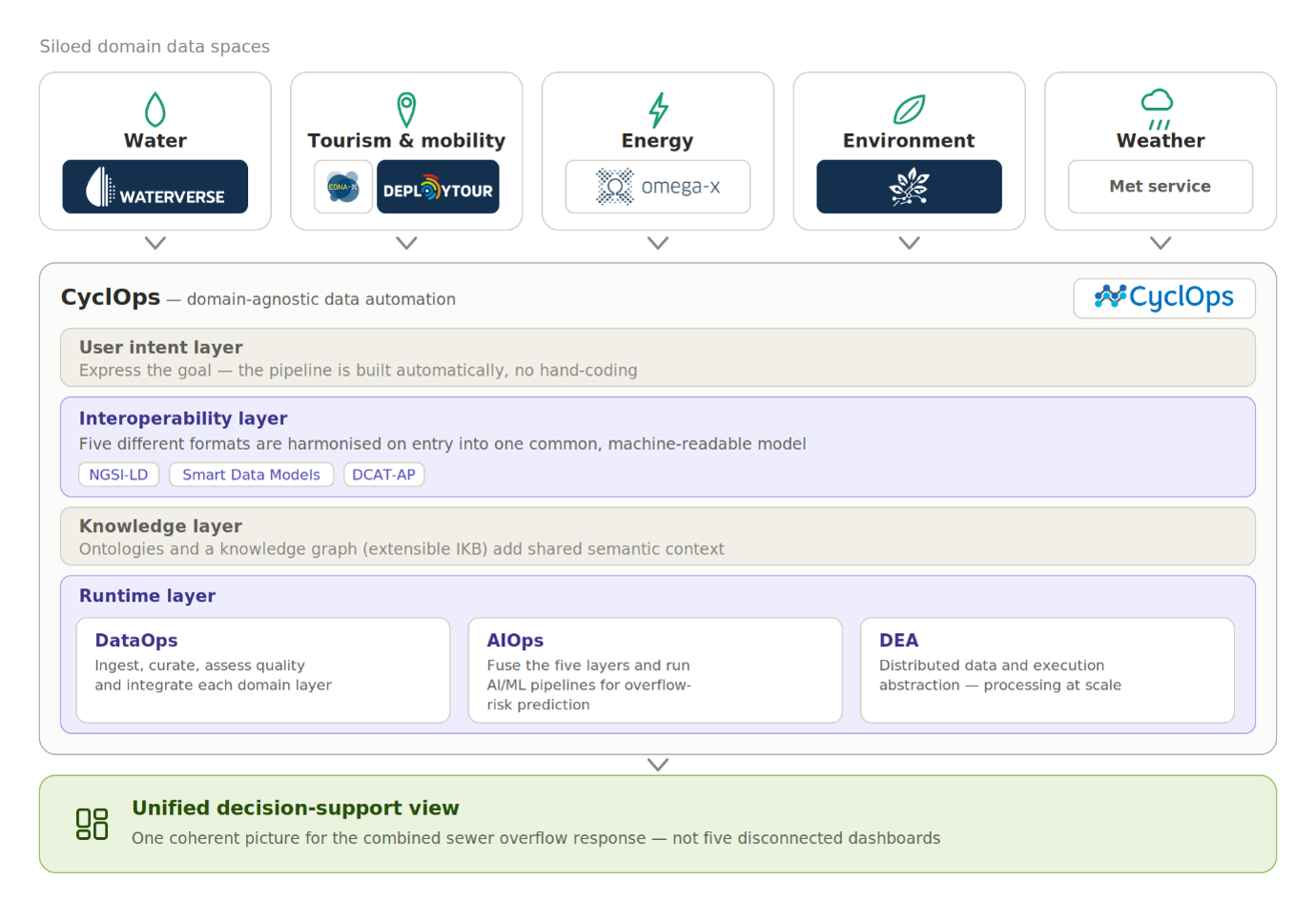
Consider a combined-sewer-overflow event in a coastal city at the height of the tourist season. To manage it well, you need far more than water-network data. You need weather data, the energy-grid status of the pumping stations, agricultural-runoff data from upstream, and even tourism data — because a seasonal surge in visitors can sharply increase the load on the sewer system and put bathing-water quality and drinking-water supply at risk.
Today, every one of those sources sits in a different silo: the water network inside legacy SCADA and telemetry systems, the weather data behind a meteorological service’s interface, the energy status in another sector entirely, the runoff data with environmental agencies and satellites, and the tourism data with third-party mobility or telecom providers. Five owners, five mandates, five formats, and no common language between them.
In the converged world we’re building, each domain contributes a trusted, harmonised layer rather than raw data. WATERVERSE plays that role for water; CyclOps does the same readying work for the other sources — drawing, for example, on mobility and tourism data through spaces such as EONA-X and Deploytour, on environmental, agricultural, and climate data through the Green Deal Data Space SAGE and on energy-grid data through the emerging Common European Energy Data Space (projects such as OMEGA-X)— and then fuses them with the water layer in a single, automated cross-domain AI/ML pipeline. The operator ends up with one coherent decision-support picture instead of five disconnected dashboards.
Turning broken silos into shared value
That is the promise behind “Breaking the Silos.” It isn’t about collecting more data — it’s about data that’s FAIR, trusted, and connected. WATERVERSE proves it in the water sector; CyclOps, domain-agnostic by design, extends it across them all — turning broken silos into shared value.